Full Arch Implant Mistakes: 8 Mistakes to Avoid Before Surgery
Full Arch Implant Mistakes: 8 Mistakes to Avoid Before Surgery
Full arch implant mistakes can have a lasting impact on your oral health and the success of your treatment. Losing several or all of your teeth can be one of the most difficult experiences in a person’s life. Once you decide to pursue full-arch dental implants, it’s natural to want treatment completed as quickly as possible.
However, full-arch treatment is not a single standardized procedure. Different providers may recommend very different surgical and restorative approaches—even when they use similar terms such as “full arch implants” or “teeth in a day.”
That is why the questions you ask before surgery matter.
Understanding these full arch implant mistakes before treatment can help you make more informed decisions and avoid unnecessary complications. While every patient has unique anatomical and restorative needs, asking the right questions before surgery can improve your understanding of the proposed treatment plan and help ensure your long-term goals are considered.
In short: the most common mistakes to avoid before full-arch dental implants include failing to ask how much bone will be removed, not understanding what the final restoration will look like, assuming every full-arch procedure is the same, skipping a second opinion, and allowing price or financing pressure to determine the treatment timeline.
Each of these mistakes can be avoided by understanding the proposed treatment plan before making an irreversible decision.
Full Arch Implant Mistake #1: Assuming Every Case Requires the Same Amount of Bone Reduction
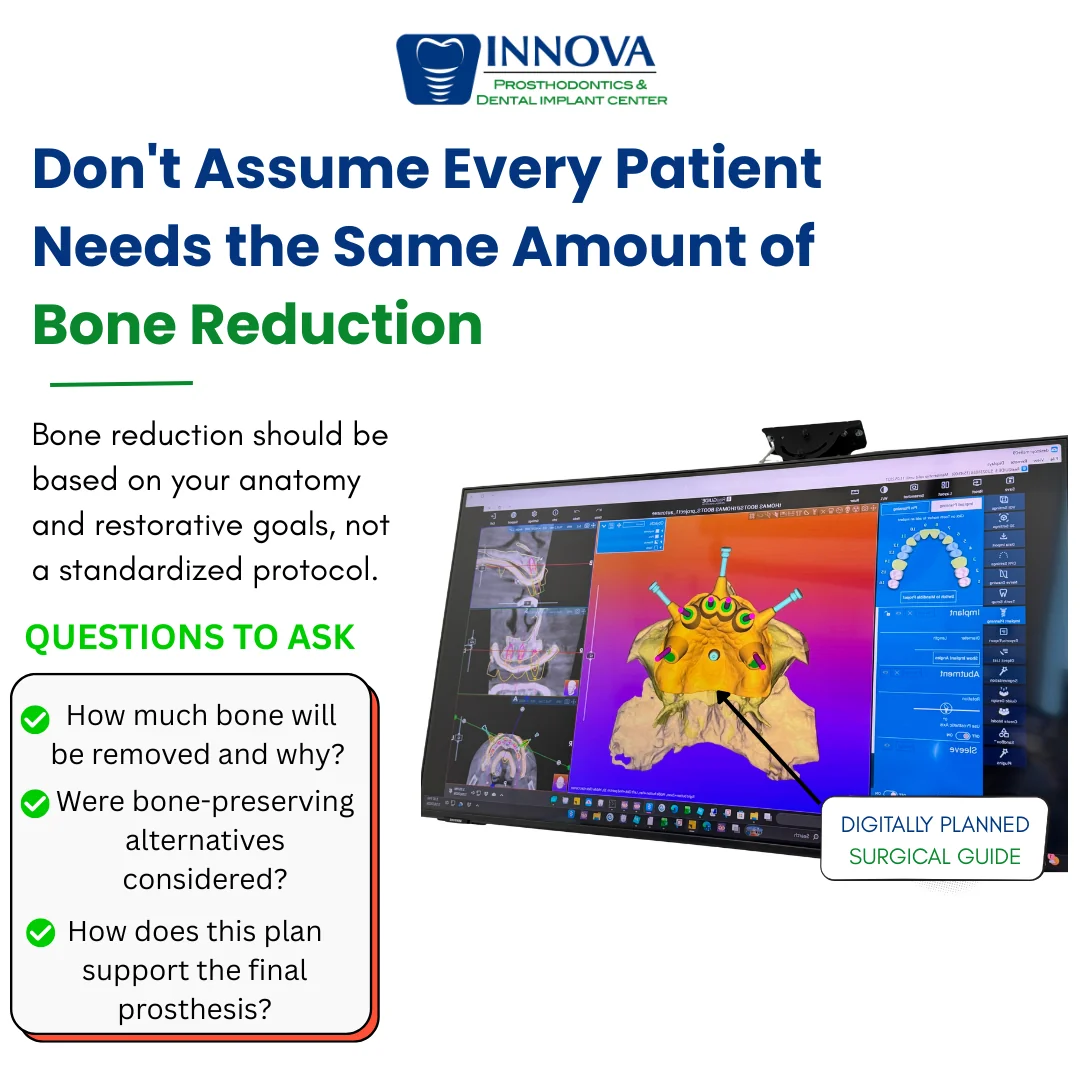
Bone reduction may be recommended during full-arch implant surgery to create restorative space, correct irregular ridge anatomy, manage the transition between the prosthesis and the gums, or provide sufficient thickness for the planned restoration.
However, bone reduction should be based on your anatomy and the requirements of the proposed restoration. It should not be applied automatically as part of a standardized surgical workflow.
Some full-arch protocols incorporate substantial bone reduction to create space for a prosthesis that replaces both teeth and missing gum tissue. Other approaches prioritize preserving healthy bone and natural soft-tissue architecture when the patient’s anatomy allows it.
Removing healthy ridge anatomy is irreversible in practical treatment-planning terms. Although bone can sometimes be augmented, rebuilding the original bone and soft-tissue architecture later may be difficult, unpredictable, or impossible.
Before approving surgery, ask:
- How much bone is expected to be removed?
- Why is that amount necessary?
- Is the reduction required by my anatomy or by the selected prosthetic design?
- Were bone-preserving alternatives considered?
- Was the decision based on a CBCT scan and a complete restorative plan?
Bone grafting should also not automatically be viewed as a complication or failure. In properly selected cases, grafting may be a deliberate part of a conservative plan designed to preserve or improve the available anatomy.
Many full arch implant mistakes occur because patients are unfamiliar with the differences between treatment approaches. Taking time to understand your provider’s recommendations, restorative philosophy, and long-term maintenance requirements can help you feel more confident before moving forward with treatment.
2. Not Asking What Your New Teeth Will Look Like
A full-arch restoration can replace teeth alone, or it can replace both teeth and missing gum and bone structures.
Patients are often unfamiliar with the distinction between prosthetic teeth and prosthetic gums.
In some cases, the replacement teeth can be designed to emerge close to the patient’s natural gumline. In other cases, the restoration includes pink acrylic, composite, or zirconia material that simulates missing gum tissue and conceals the transition between the prosthesis and the jaw.
Both designs can be appropriate. The correct design depends on factors such as:
- Existing bone and soft-tissue loss
- Lip position and smile line
- Restorative space
- Tooth proportions
- Hygiene access
- The desired esthetic outcome
Ask to see photographs of patients whose starting anatomy was similar to yours—not only ideal finished cases.
You should also ask:
- Will my restoration include pink prosthetic gum material?
- Where will the transition between the prosthesis and my natural tissue be located?
- Will that transition be visible when I smile?
- Who is designing the teeth, bite, and gum contours?
- Will I have an opportunity to evaluate a provisional or prototype before the definitive restoration is made?
3. Not Asking Whether Natural Teeth Can Be Saved
Full-arch dental implants are sometimes presented as the obvious solution when several teeth are damaged or missing. Nevertheless, having multiple compromised teeth does not automatically mean every remaining tooth must be extracted.
The correct question is not simply whether a tooth can technically be saved. The more meaningful question is whether it has a reasonable long-term prognosis and whether retaining it supports—or compromises—the overall reconstruction.
A comprehensive evaluation should consider:
- Remaining tooth structure
- Periodontal support
- Root fractures or decay
- Endodontic prognosis
- Strategic importance of each tooth
- The patient’s bite
- The feasibility of maintaining the tooth
- How retaining the tooth affects the full treatment plan
In some patients, complete replacement is the most predictable option. In others, selected natural teeth may be maintained as part of a more conservative plan.
Before agreeing to remove all remaining teeth, ask:
- Which teeth have a reasonable long-term prognosis, and which teeth would compromise the reconstruction if they were retained?
A prosthodontic second opinion may be particularly valuable when the decision involves choosing between preserving teeth and replacing an entire arch.
Full Arch Implant Mistake #4: Choosing a Provider Based on Price Alone
The cost of full mouth dental implants varies considerably. As a result, patients may be tempted to compare treatment plans as though the implants themselves were the only meaningful difference.
However, the fee may also reflect:
- Diagnostic records and CBCT imaging
- Digital treatment planning
- Surgical guide fabrication
- The number and type of implants
- Bone grafting or soft-tissue procedures
- Sedation services
- Provisional restorations
- Laboratory involvement
- Definitive restorative materials
- Prosthodontic design
- Follow-up visits and maintenance
A lower fee does not automatically mean inferior care. Likewise, a higher fee does not guarantee a superior result.
The important question is whether you are comparing equivalent treatment plans.
Ask each provider to explain exactly what is included, what is excluded, and how the proposed approach differs from the alternatives.
Choosing a provider involves much more than comparing prices. One of the most common full arch implant mistakes is assuming that every treatment plan includes the same procedures, materials, and level of planning. A detailed discussion of what is included in your treatment can help you make a more informed comparison.
5. Treating “Teeth in a Day” as the Final Result
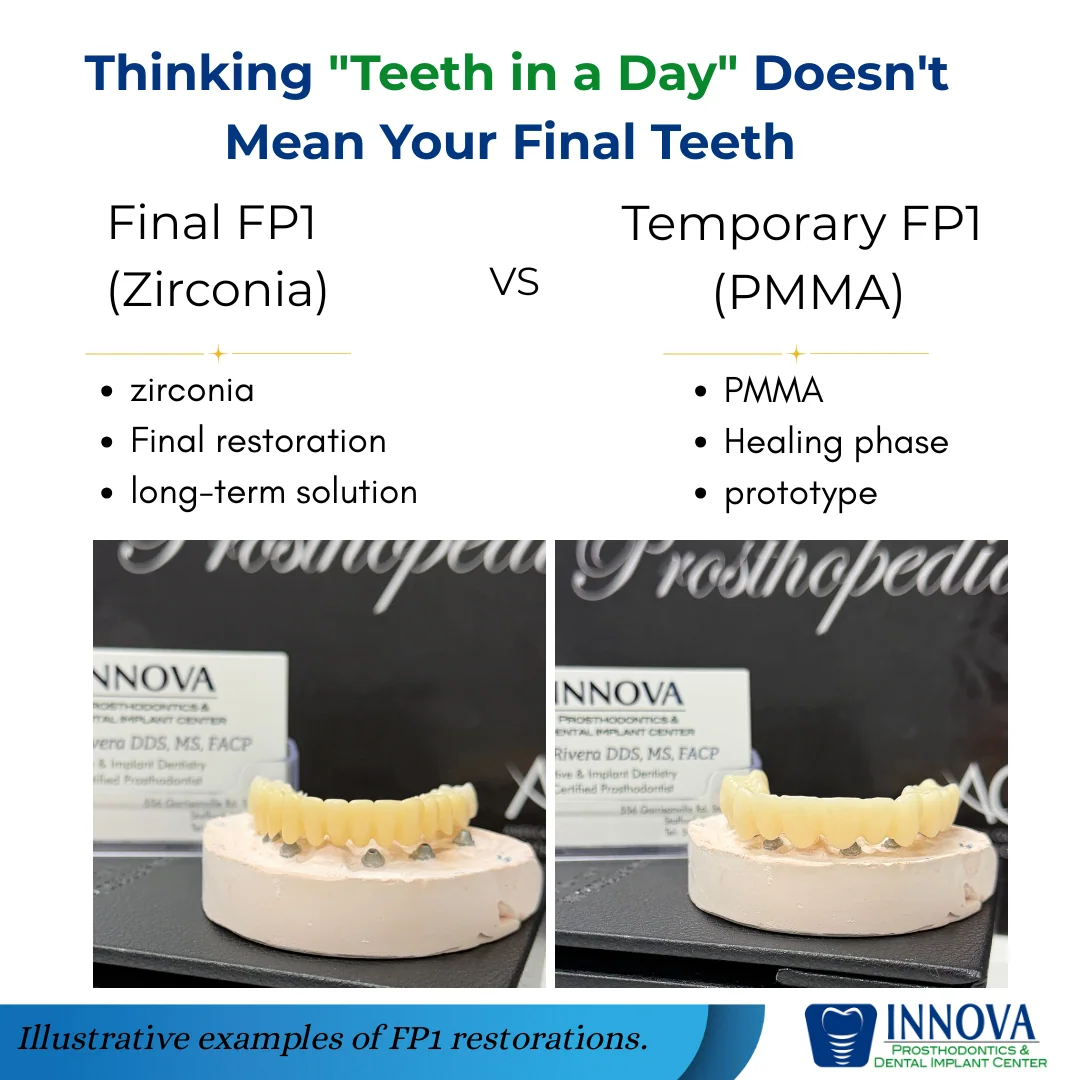
“Teeth in a day” usually refers to the placement of a provisional restoration soon after implant surgery. It does not necessarily mean that the final definitive teeth are completed in one appointment.
Many protocols use a resin-based, acrylic, nanoceramic, or PMMA provisional restoration during the healing period. This provisional protects the surgical plan, allows the patient to leave with teeth, and provides an opportunity to evaluate esthetics, speech, and function.
Meanwhile, the implants undergo osseointegration—the biological process through which they become integrated with the surrounding bone.
After healing, new records may be taken before the definitive restoration is fabricated. The final prosthesis may be made from monolithic zirconia or another material selected according to the patient’s restorative design.
Before surgery, ask:
- Is the first set of teeth provisional or definitive?
- When is the final restoration expected?
- What material will be used?
- How many follow-up appointments are included?
- What happens if the implants lack sufficient stability for immediate fixed teeth?
Immediate provisionalization is not appropriate in every case. It depends on implant stability, bone conditions, the distribution of the implants, and the accuracy of the clinical records.
6. Assuming All Full-Arch Procedures Are the Same
“Full arch dental implants” describes a category of treatment, not one universal procedure.
Depending on the patient’s anatomy and diagnosis, treatment may involve:
- Different numbers and distributions of implants
- Straight or angled implant placement
- All-on-4® or All-on-6–type configurations
- Conventional implants
- Pterygoid or zygomatic implants in selected cases
- Bone grafting
- Fixed or removable restorations
- Prostheses that replace teeth only
- Prostheses that replace both teeth and missing tissues
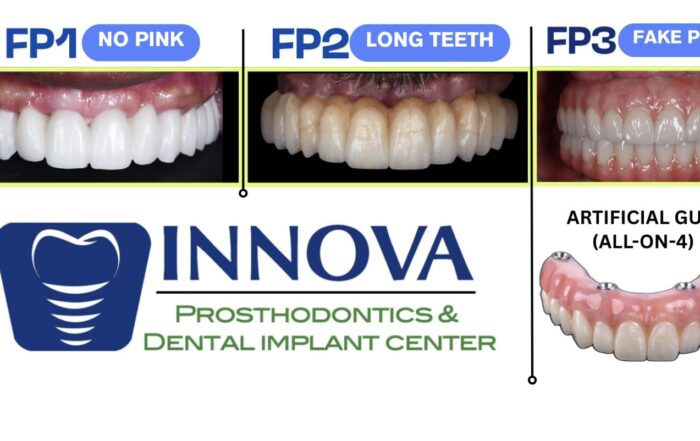
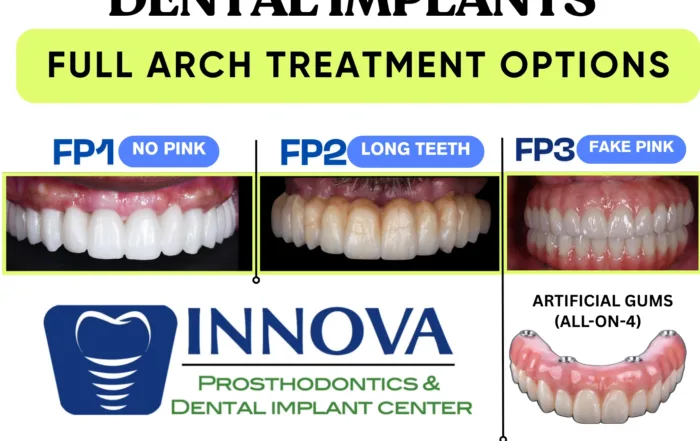
You may also hear the terms FP1 and FP3.
An FP1 restoration primarily replaces the clinical crowns of the missing teeth and relies on the patient’s natural gum architecture for the appearance of tooth emergence. An FP3 restoration replaces the teeth as well as missing gingival and alveolar structures using prosthetic material.
Neither design is appropriate for every patient.
The treatment should be selected based on your anatomy, tissue loss, smile line, functional needs, and long-term prognosis—not simply on the name of a marketed procedure.
Avoiding full arch implant mistakes begins with understanding that no single treatment approach is appropriate for every patient. Factors such as bone volume, soft tissue, smile line, bite, esthetic goals, and long-term prognosis should guide the treatment plan rather than marketing terminology alone.
7. Getting Only One Opinion
Many patients attend one consultation, receive a confident presentation, and commit to treatment on the same day.
Confidence can be reassuring. However, it does not eliminate the value of an independent second opinion.
A second opinion is not necessarily about finding a lower fee. It is about determining whether:
- Other teeth could be maintained
- Less bone reduction may be possible
- A different prosthetic design should be considered
- Grafting would improve the outcome
- The proposed transition line will be visible
- Immediate loading is appropriate
- Another treatment sequence may be safer or more conservative
The second provider may confirm the original plan. That confirmation itself can provide valuable confidence.
Alternatively, the evaluation may introduce an option that was not previously discussed.
You cannot evaluate alternatives you were never shown.
Full Arch Implant Mistake #8: Allowing Financing Pressure to Determine the Timeline
Full-arch treatment is a major clinical and financial decision. Financing can make care accessible, but it should not create artificial urgency.
Same-day discounts, limited-time offers, and immediate financing approvals can make patients feel that they must commit before they have fully reviewed the diagnosis.
In most elective full-arch cases, taking reasonable time to understand the plan is safer than committing under sales pressure. However, urgent infection, pain, or rapidly deteriorating teeth should still be addressed promptly.
Before signing, make sure you understand:
- The total treatment fee
- Which procedures are included
- Whether provisional and definitive restorations are included
- What happens if additional grafting is required
- The financing terms and interest
- Which payments become nonrefundable once laboratory or surgical work begins
- What maintenance will cost after treatment
Financing should support a well-informed decision. It should not make the decision for you.
How to Avoid Full Arch Implant Mistakes
The best way to avoid full arch implant mistakes is to ask questions, understand your treatment options, and seek a comprehensive evaluation before committing to surgery. Whether your treatment involves bone grafting, immediate provisionalization, FP1 or FP3 restorations, or another approach, the goal should be a treatment plan based on your individual anatomy, function, and long-term oral health—not a one-size-fits-all solution.
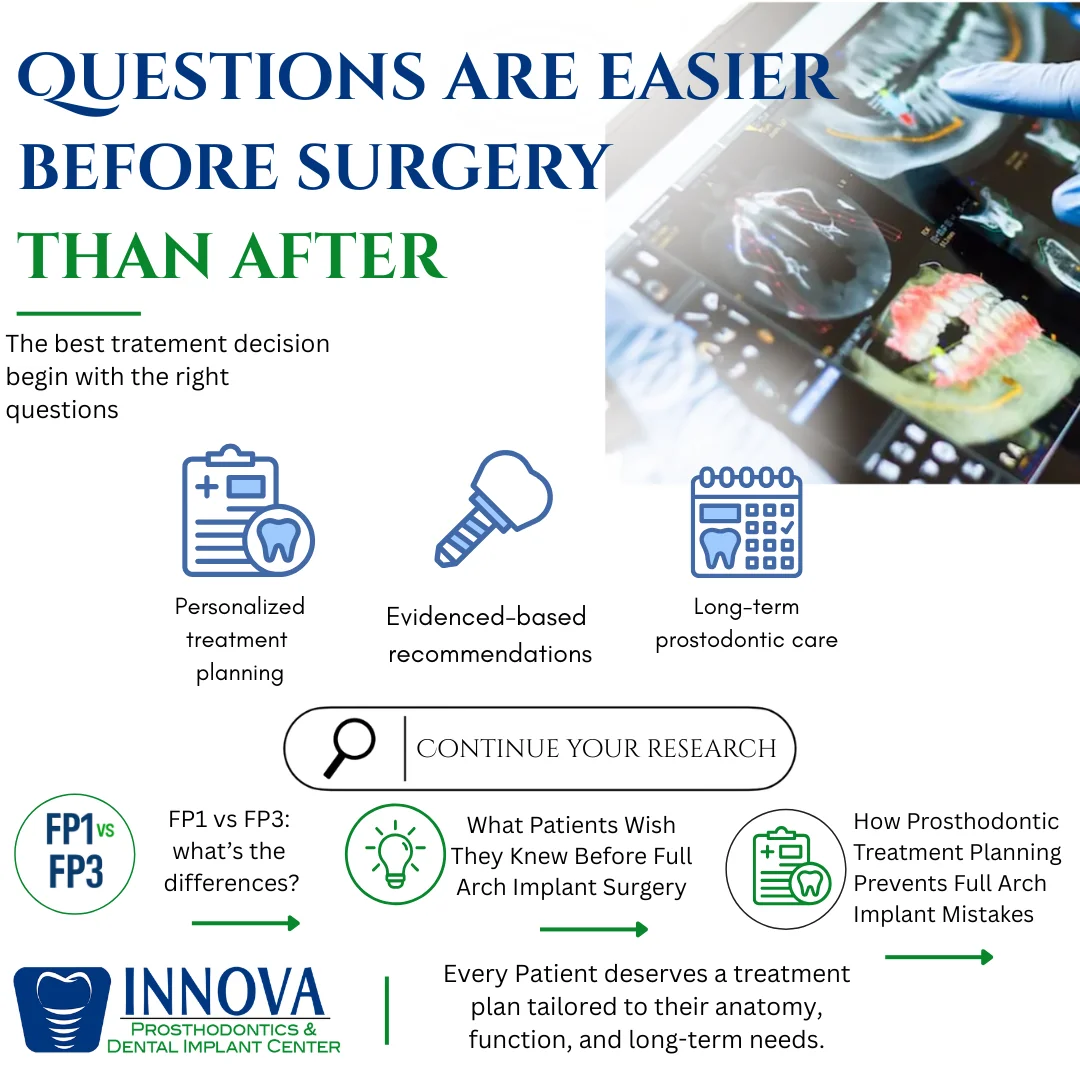
Questions Are Easier Before Surgery Than After
Choosing full-arch dental implants is not simply a decision to replace missing teeth.
It is a decision about:
- Which teeth should be removed or preserved
- How much bone and tissue should be maintained
- Where the implants should be positioned
- Whether the restoration will include prosthetic gums
- How the bite will be designed
- Who will be responsible for the final prosthesis
- How the restoration will be maintained over time
Understanding these full arch implant mistakes before surgery allows you to ask better questions and make a more informed treatment decision. Whether you ultimately choose one practice or another, make sure you understand the treatment philosophy and the proposed result before committing.
A second opinion may confirm that you are on the right path. It may also reveal an option you did not know existed.
Continue Your Research
- FP1 vs. FP3: What Is the Difference?
- What Patients Wish They Knew Before Full Arch Implant Surgery
- How Prosthodontic Treatment Planning Prevents Full Arch Implant Mistakes
Individual recommendations require a clinical examination, appropriate diagnostic imaging, and a complete review of the patient’s medical and dental history.